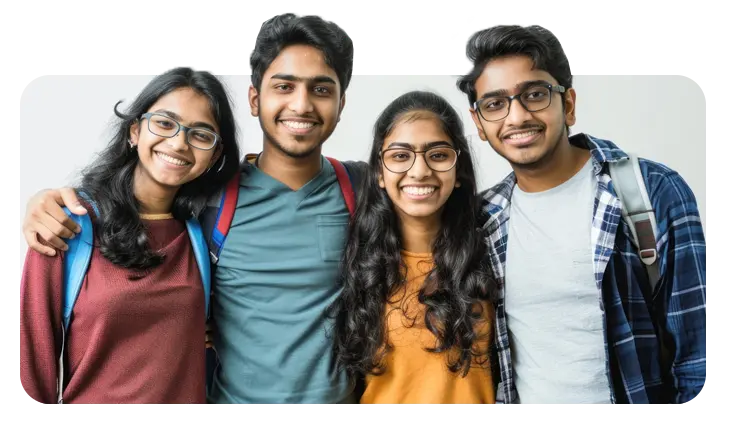

B. Tech Civil Engineering Program is designed to empower aspiring engineers as an ‘Industry Ready Professional’ with the knowledge, skills, and experience. The student will embark on a transformative educational journey of skills, innovation, and hands-on learning. The program is aimed to shape the next generation of innovative and ethical civil engineers. Discover the potential and make a lasting impact on society to build a career that matters.
The B. Tech program in Civil Engineering is a four-year full-time program consisting of foundational courses as part of a common curriculum as students can opt to specialize in a track of their choice.
This Program is designed to be relevant for industry as well as the society needs in both the local and global context. The holistic development approach in teaching learning process emphasizes on project work and providing industry exposure via internships, industry projects, visits to companies, as well as real life case projects. Regular interactions with industry experts will help build a bridge between the students and the industry.
| Semester 1 | |
|---|---|
| Basic Civil & Construction Engineering (Theory) | |
| Basic Civil & Construction Engineering (Lab) | |
| Applied Science (Theory) | |
| Applied Science (Lab) | |
| Computational Thinking with Python (Theory) | |
| Computational Thinking with Python (Lab) | |
| Engineering Mathematics – I (Theory) | |
| Basics of Digital Drafting (Lab) | |
| Soft Skills (Lab) | |
| Universal Human Values (Lab) | |
| Semester II | |
|---|---|
| Building Technology & Services | |
| Engineering Mechanics | |
| Basic Electrical (Theory) | |
| Basic Electrical (Lab) | |
| Engineering Mathematics – II (Theory) | |
| Design Thinking and Fabrication Techniques (Theory) | |
| Design Thinking and Fabrication Techniques (Lab) | |
| Sustainable Materials and Technology (Theory) | |
| Sustainable Materials and Technology (Lab) | |
| Vedic Mathematics | |
Exit Options to Qualify for Certification: Any Two Skill-Based Courses
|
|
| Semester III | |
|---|---|
| Strength of Materials (Theory) | |
| Strength of Materials (Lab) | |
| Artificial Intelligence and Data Science (Theory) | |
| Artificial Intelligence and Data Science (Lab) | |
| Concrete Technology (Theory) | |
| Concrete Technology (Lab) | |
| Surveying and Geomatics (Theory) | |
| Surveying and Geomatics (Lab) | |
| Infrastructure and Town Planning Engineering (Theory) | |
| Rural Internship (Lab) | |
| Professional Skills - I (Lab) | |
| Biology for Engineers (Lab) | |
| Semester IV | |
|---|---|
| Structural Analysis (Theory) | |
| Hydraulic Engineering (Theory) | |
| Hydraulic Engineering (Lab) | |
| Geotechnical Engineering (Theory) | |
| Geotechnical Engineering (Lab) | |
| Project Management | |
| Engineering Drawing and Building Information Modelling (BIM) (Lab) | |
| Technology Management and Commercialization (Theory) | |
| Foreign Language (Lab) | |
| Professional Skills - II (Lab) | |
Exit Options to Qualify for Diploma: Any One Skill-Based Course and Mini Project
|
|
| Semester V | |
|---|---|
| Optimization Techniques (Theory) | |
| Design of Steel Structure (Theory) | |
| Design of Steel Structure (Lab) | |
| Water Resource & Environmental Engineering (Theory) | |
| Transportation Engineering (Theory) | |
| Transportation Engineering (Lab) | |
| Elective I (Theory) | |
| Elective I (Lab) | |
| Professional Skills - III (Lab) | |
| Industrial Internship (Lab) | |
| Semester VI | |
|---|---|
| Construction Project Management (Theory) | |
| Intelligent Transport Systems (Theory) | |
| Intelligent Transport Systems (Lab) | |
| Engineering Economics and Finance (Theory) | |
| Design of Reinforced Concrete Structure (Theory) | |
| Design of Reinforced Concrete Structure (Lab) | |
| Elective II (Theory) | |
| Elective II (Lab) | |
| Computer Aided Design (Lab) | |
| Professional Skills - IV (Lab) | |
Exit Options to Qualify for B Voc: Any Two Courses
|
|
| Semester VII | |
|---|---|
| Foundation Engineering (Theory) | |
| Construction Technology and Digital Twinning (Theory) | |
| Construction Technology and Digital Twinning (Lab) | |
| Structural Health Monitoring (Theory) | |
| Structural Health Monitoring (Lab) | |
| Elective III (Theory) | |
| Elective III (Lab) | |
| Open Elective (Theory) | |
| Open Elective (Lab) | |
| Research Internship (Lab) | |
| Semester VIII | |
|---|---|
| Capstone Project (Lab) | |
Elective 1
|
|
Elective 2
|
|
Elective 3
|
|
Elective 4
|
|
The proposed track on Infrastructure Engineering, as it is expected to 30 million employment in the civil engineering sector by 2030. Infrastructure industry required competent civil engineers, with a focus on skill development, particularly in practical and tutorial sessions. Deep comprehension of infrastructure project design and development Students will acquire proficiency in digitalized tools and processes in addition to embracing fundamental traditional skill sets in order to survive in today's future construction environment. Using judgment and problem-solving techniques when working on building projects.
Passed 10+2 examination with Physics, Chemistry, and Mathematics. Obtained at least 45% marks (40% marks in case of candidates belonging to reserved category) in the above subjects taken together.
Lateral Entry to Second Year for All Engineering Programs of SEMR
Passed minimum THREE years / TWO years (Lateral Entry) Diploma examination with at least 45% marks (40% marks in case of candidates belonging to reserved category) in ANY branch of Engineering and Technology.
OR
Passed B.Sc. Degree from a recognized University as defined by UGC, with at least 45% marks (40% marks in case of candidates belonging to reserved category) and passed 10+2 examination with Mathematics as a subject.
OR
Passed B.Voc / 3-year D.Voc. Stream in the same or allied sector.
Phy, Chem, Maths
Students with good scores in MH-CET, JEE, PERA CET, CUET, or any other equivalent competitive exams, DYPIU Entrance Test and/or Personal Interaction
Passed Minimum THREE years / TWO years (Lateral Entry) Diploma examination with at least 45% marks (40% marks in case of candidates belonging to reserved category) in ANY branch of Engineering and Technology.
OR
Passed B.Sc. Degree from a recognized University as defined by UGC, with at least 45% marks (40% marks in case of candidates belonging to reserved category) and passed 10+2 examination with Mathematics as a subject.
OR
Passed B.Voc/3-year D.Voc. Stream in the same or allied sector. (The Universities will offer suitable bridge courses such as Mathematics, Physics, Engineering drawing, etc., for the students coming from diverse backgrounds to achieve desired learning outcomes of the programme)
*Semester fees may change as per approval from Fee Fixation Committee
To encourage the merit in education at DYPIU, scholarships are planned for meritorious students of B. Tech Program Civil Engineering
| Examination | JEE | % Scholarship as percentage of Tuition Fees | Category |
|---|---|---|---|
| Score range for Scholarship | All India Rank below 25000 (included) | 50% | A |
| All India Rank above 25000 below 60000 (included) | 25% | B | |
| All India Rank above 60000 below 150000 (included) | 15% | C |
| Examination | MH-CET/ 10+2 examination from any Board | % Scholarship as percentage of Tuition Fees | Category |
|---|---|---|---|
| Score range for Scholarship | 95 (included) and above | 50% | A |
| Between 90 (included) and 95 | 25% | B | |
| Between 85 (included) and 90 | 15% | C | |
| 75% in 10+2 examination | 10% | D |
- Number of scholarships in Category A: 05
- Number of scholarships in Category B: 05
- Number of scholarships in Category C: 10
- Number of scholarships in Category D: 10
Civil engineering is a branch of engineering that deals with the design, construction, and maintenance of infrastructure projects, such as buildings, bridges, roads, and water supply systems. Civil engineers use principles of physics, mathematics, and materials science to ensure the safe and efficient development of these essential structures.
All the students graduating from B. Tech. Civil Engineering will get the same degree. Their track names will be specified in their degree as well.
There are three prime focus areas of internships:
During the semester breaks, students can perform internships in or outside of the University. However, during the semesters, students are advised to do the internships in the University to ease their attendance in the class and lab works.
60
Civil engineering offers a diverse array of career opportunities across various sectors. Graduates can pursue roles in construction, where they manage and supervise building projects, ensuring they meet design specifications and safety standards. Infrastructure development, including roads, bridges, and airports, provides another avenue for civil engineers, involving planning, design, and execution of large-scale projects. Transportation engineering centres on designing efficient and safe transportation systems. Structural engineering deals with the analysis and design of structures, while water resources engineering focuses on managing water supply and distribution. Government agencies, consulting firms, and private companies all seek civil engineering expertise, offering roles in project management, design, and consulting. With the increasing emphasis on sustainable practices, civil engineers play a vital role in green building and urban planning.
Students can take open electives from other departments. However, the choice of elective will be subject to availability during that semester and also to capacity of the class.
In terms of curriculum and core subjects, there's usually no significant difference between a Bachelor of Technology (B.Tech) and a Bachelor of Engineering (BE) in Civil Engineering. Both degrees generally cover similar foundational concepts, including Analysis, Design, Planning, Estimating and costing etc. However, the difference often lies in the emphasis of the programs:
Completing a B.Tech in Civil Engineering opens up a diverse range of career opportunities across various industries in following domain but not limited to
YES! After acquiring the B. Tech degree in Civil Engineering students are eligible for Professional licensure which is often required for civil engineers, especially those involved in public projects. It demonstrates your expertise and commitment to ethical and safety standards.
Joining relevant clubs, participating in engineering competitions, attending conferences, and engaging in community service can enhance your skills and make you stand out to potential employers.
A Project Manager oversees the entire project, from planning to completion. Their responsibilities include budget management, scheduling, team coordination, risk assessment, and ensuring compliance with quality and safety standards.













The Centre of Excellence with Ultratech Cement Limited represents a initiative aimed at fostering advanced capabilities, driving transformative initiatives, and elevating our department to new heights of proficiency and efficiency. The primary purpose of the COE is to serve as a hub of expertise in Civil Engineering, dedicated to specialized knowledge and best practices. It will act as a catalyst for excellence by promoting collaboration, research, and the implementation of cutting-edge solutions in concrete works. Our Centre of Excellence will focus on Ready mix concrete design, cement manufacturing process and advance water proofing technology. As we embark on this journey, the members of Ultratech Cement limited actively engage with the COE to share insights and collaborate in the pursuit of excellence for elevating our department to new levels of achievement.
Knowledge Creation and Dissemination with students and researchers,
| Program Outcomes | |
|---|---|
| POs | Program Outcomes |
| PO1 | Engineering knowledge Apply the knowledge of mathematics, natural sciences, engineering fundamentals, and an engineering specialization to develop solutions for complex engineering problems. |
| PO2 | Problem analysis Identify, formulate, review research literature, and analyze complex engineering problems using first principles of mathematics, natural sciences, and engineering sciences, while considering the holistic nature of the problem to reach substantiated conclusions. |
| PO3 | Design/development of solutions Design solutions for complex engineering problems and design system components or processes that meet specified needs with due consideration for public health and safety, as well as cultural, societal, environmental, and sustainability requirements. |
| PO4 | Conduct investigations of complex problems Conduct investigations using research-based knowledge and research methods, including the design of experiments, analysis and interpretation of data, and synthesis of information to provide valid conclusions. |
| PO5 | Engineering tool usage Create, select, and apply appropriate modern engineering, digital, and IT tools, including modelling, simulation, prediction, and data analysis techniques, to complex engineering activities with an understanding of their limitations. |
| PO6 | The engineer and the world Analyze and evaluate societal, environmental, sustainability, legal, cultural, health, safety, and contemporary issues, and understand the impact of engineering solutions on society and the world while fulfilling professional responsibilities. |
| PO7 | Ethics Apply ethical principles, professional responsibilities, engineering norms, and human values with respect for diversity, equity, inclusion, and sustainable professional practice. |
| PO8 | Individual and collaborative team work Function effectively as an individual, and as a member or leader in diverse, multidisciplinary, and collaborative teams to achieve common engineering goals. |
| PO9 | Communication Communicate effectively on complex engineering activities with the engineering community and society through effective reports, technical documentation, presentations, and clear oral and written communication. |
| PO10 | Project management and finance Apply engineering and management principles, financial practices, and project management techniques to individual and multidisciplinary engineering projects while working effectively as a member or leader of a team. |
| PO11 | Life-long learning Recognize the need for, and demonstrate the ability to engage in independent and lifelong learning to adapt to technological advancements, innovation, and evolving professional practices. |
| Program Educational Objectives (PEOs) | |
|---|---|
| PEOs | Program Educational Objectives |
| PEO1 | Graduates will design, analyses and develop engineering solutions that meet the needs of various industries. |
| PEO2 | Graduates will continue their education in engineering an interdisciplinary area to emerge as experts, educators, entrepreneurs and researchers in their chosen fields. |
| PEO3 | Graduates will work effectively as a part of teams on multidisciplinary projects. |
| PEO4 | Graduates will exhibit strong leadership, inter-personal and communication skills with concern for society and environment. |
| Program Specific Outcomes (PSOs) | |
|---|---|
| PSOs | Program Specific Outcomes |
| PSO1 | Graduates will be able to apply principles of mathematics, science, and engineering to identify, formulate, and solve complex civil engineering problems by utilizing modern tools and techniques and adept in professional practice, including ethical decision-making, effective communication, teamwork, and project management in the civil engineering field. |
| PSO2 | Graduates will demonstrate the ability to design civil engineering projects that meet specified needs of public health, safety, cultural, societal, and environmental impacts, promoting sustainable development. |