
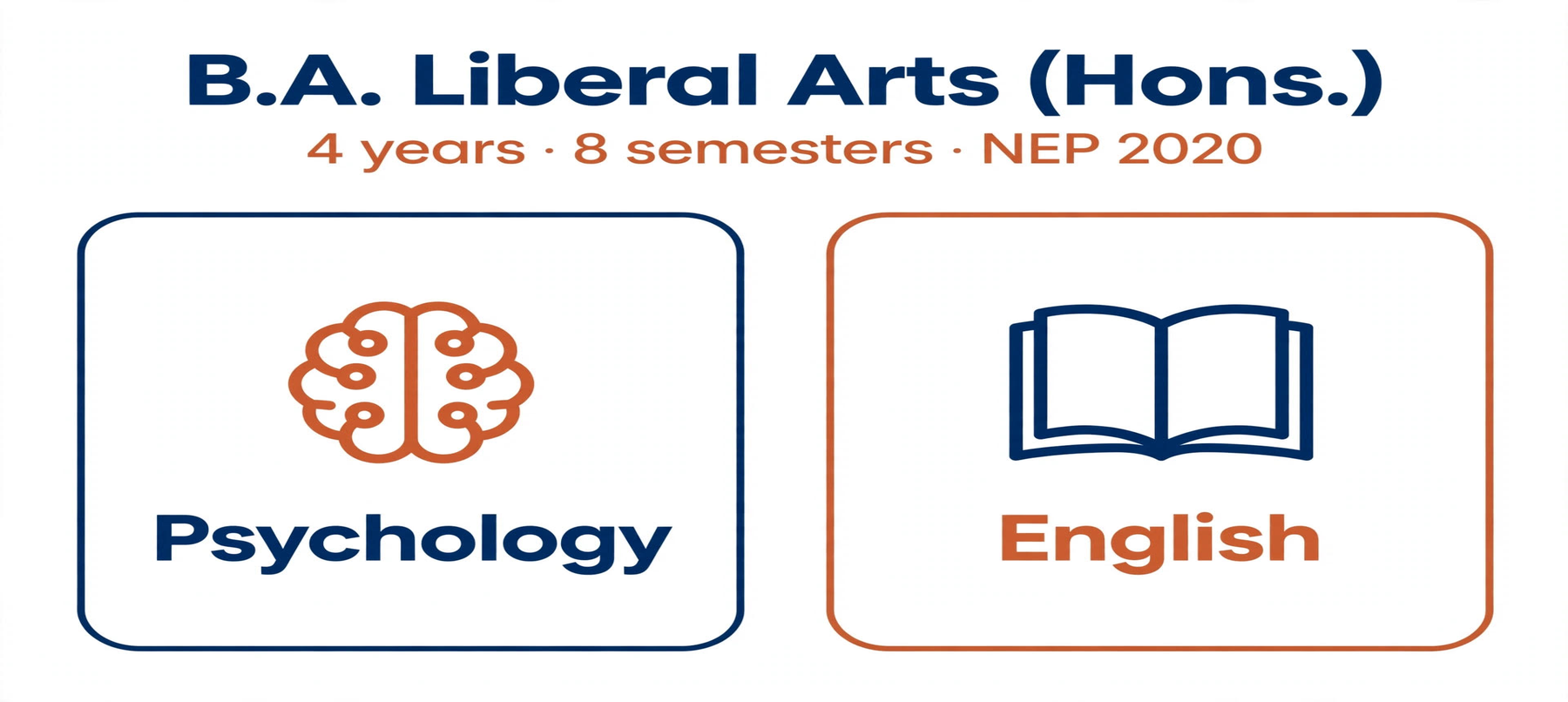
The B.A. (Hons./Hons. with Research) Liberal Arts programme is a flexible, interdisciplinary four-year programme aligned with NEP 2020, offering students a strong foundation in Humanities and Social Sciences with specialisation options in Psychology or English. The curriculum integrates Psychology, English Literature, Statistics, Digital Humanities, Artificial Intelligence, Sustainability, Ethics, Global Studies, and other contemporary areas while developing critical thinking, communication, creativity, research, and analytical skills.
The programme emphasises experiential learning through internships, field projects, interdisciplinary activities, and research. Students specialising in Psychology gain knowledge across major areas of psychology, while the English track develops expertise in literature, language, translation, and creative writing. Graduates are prepared for diverse careers in HR, education, media, research, publishing, NGOs, corporate communication, public policy, and other people- and knowledge-oriented sectors, as well as postgraduate studies.
Upon successful completion of the B.A. (Hons.) Liberal Arts programme, graduates will be able to:
Courses shall include Continuous Assessment, Mid-Term Examinations, and End-Term Examinations, as determined by the School. Certain courses may be evaluated entirely through Continuous Assessment, depending on their nature and learning outcomes.
Student performance in each course shall be evaluated using an absolute grading system. To successfully pass a course, students must independently satisfy the minimum passing requirements in the Continuous Assessment, the Mid-Term Examinations, and the End-Term Examination components (where applicable).
A minimum grade point of 4.00 is required to pass a course. Students securing less than 40% in any evaluation component shall be declared “Fail” in that course.
The University shall award a Certificate, Diploma, Degree, or Degree with Honours to students who attain a minimum cumulative grade point average (CGPA) of 4.00 on a 10-point scale in the respective programme, subject to the fulfilment of all prescribed academic requirements.
Graduates of the Psychology track develop a strong understanding of human behaviour, cognition, and social interaction, along with analytical and research skills that are highly valued across people-oriented professions. The interdisciplinary nature of the programme enables students to apply psychological principles in organisational, educational, and community contexts.
Potential career pathways include:
The track also provides a strong foundation for postgraduate studies in Psychology, including areas such as Counselling Psychology, Organisational Psychology, Clinical Psychology (with further professional training), Applied Psychology, Behavioural Sciences, and other interdisciplinary programmes.
Graduates of the English track acquire advanced competencies in literary analysis, critical interpretation, communication, and creative expression. The programme prepares students for a wide range of careers that require strong writing, analytical thinking, cultural awareness, and communication skills.
Potential career pathways include:
The programme also prepares students for higher studies in English, Literature, Cultural Studies, Media Studies, Communication, Linguistics, Public Policy, and other interdisciplinary humanities programmes.
The B.A. (Hons.) Liberal Arts programme at the School of Humanities and Social Sciences, D Y Patil International University, Akurdi, Pune offers a distinctive undergraduate experience that combines academic depth, interdisciplinary learning, and real-world engagement. Designed in alignment with the National Education Policy (NEP) 2020, the programme prepares students to become thoughtful scholars, adaptable professionals, and responsible global citizens.
The Psychology track provides students with a comprehensive and scientifically grounded understanding of human behaviour, cognition, and mental processes. The curriculum is designed to build a strong conceptual foundation across key domains of psychology while equipping students with essential research and analytical skills required to study human behaviour in diverse social and organisational contexts.
Students engage with core areas of psychology, enabling them to explore how individuals think, learn, interact, and adapt within complex social environments. These areas provide insights into psychological processes including perception, memory, motivation, personality, emotional regulation, group dynamics, workplace behaviour, and psychological well-being.
The track is further strengthened by training in Research Methodology and Statistics, which equip students with the ability to design and conduct psychological research, analyse behavioural data, and interpret empirical findings using both qualitative and quantitative approaches. Through structured coursework, students develop competencies in research design, data analysis, critical evaluation of scientific literature, and academic writing.
Experiential learning forms a key component of the track. Field engagement, internships, and project-based learning allow students to observe and analyse human behaviour in real-world settings such as educational institutions, organisations, community initiatives, and social service environments. These experiences foster practical understanding of psychological principles and ethical considerations in working with individuals and groups.
The track also prepares graduates for research-oriented pathways, mental health–adjacent roles in non-clinical settings, and people-centred professions such as human resources, organisational development, learning and development, counselling support services, community development, and social impact organisations. It also provides a strong foundation for postgraduate studies in psychology and related interdisciplinary fields.
The English track offers students a rich engagement with literature, language, and cultural expression across historical periods and global contexts. The curriculum fosters critical thinking, interpretive skills, and creative expression by encouraging students to explore literary texts as reflections of social, cultural, and philosophical ideas.
Students study a wide range of literary traditions including British, American, Indian, and World Literatures, examining how literary works engage with themes such as identity, power, culture, colonialism, gender, and social transformation. These courses provide both historical and theoretical perspectives, enabling students to analyse literary texts within their broader cultural and intellectual contexts.
The track also incorporates specialised courses such as Indian Writing in English, Translation Studies, Literary Forms and Movements, and Creative Writing, which allow students to explore diverse modes of literary production and interpretation. Through these courses, students develop skills in textual analysis, critical theory, literary criticism, and original writing across genres including fiction, poetry, essays, and narrative storytelling.
Research-oriented training is provided through Research Methodology, enabling students to undertake independent literary research, develop scholarly arguments, and engage with academic discourse in the field of literary and cultural studies.
Beyond the classroom, the programme encourages public-facing literary engagement, providing opportunities for students to participate in literary festivals, book discussions, cultural events, storytelling initiatives, and creative writing forums. Such activities strengthen interpretive, communicative, and cultural competencies while exposing students to contemporary literary and cultural conversations.
Graduates of the English track are well prepared for careers in media and content development, publishing, corporate communication, education, cultural and creative industries, journalism, and digital storytelling, as well as for advanced study in English, literature, cultural studies, communication, functional English and related disciplines.
Duration – 48 months (Multiple Entry–Exit Framework).
English
Semester
*Semester fee are subject to change as per the approval of the Fee Fixation Committee.