
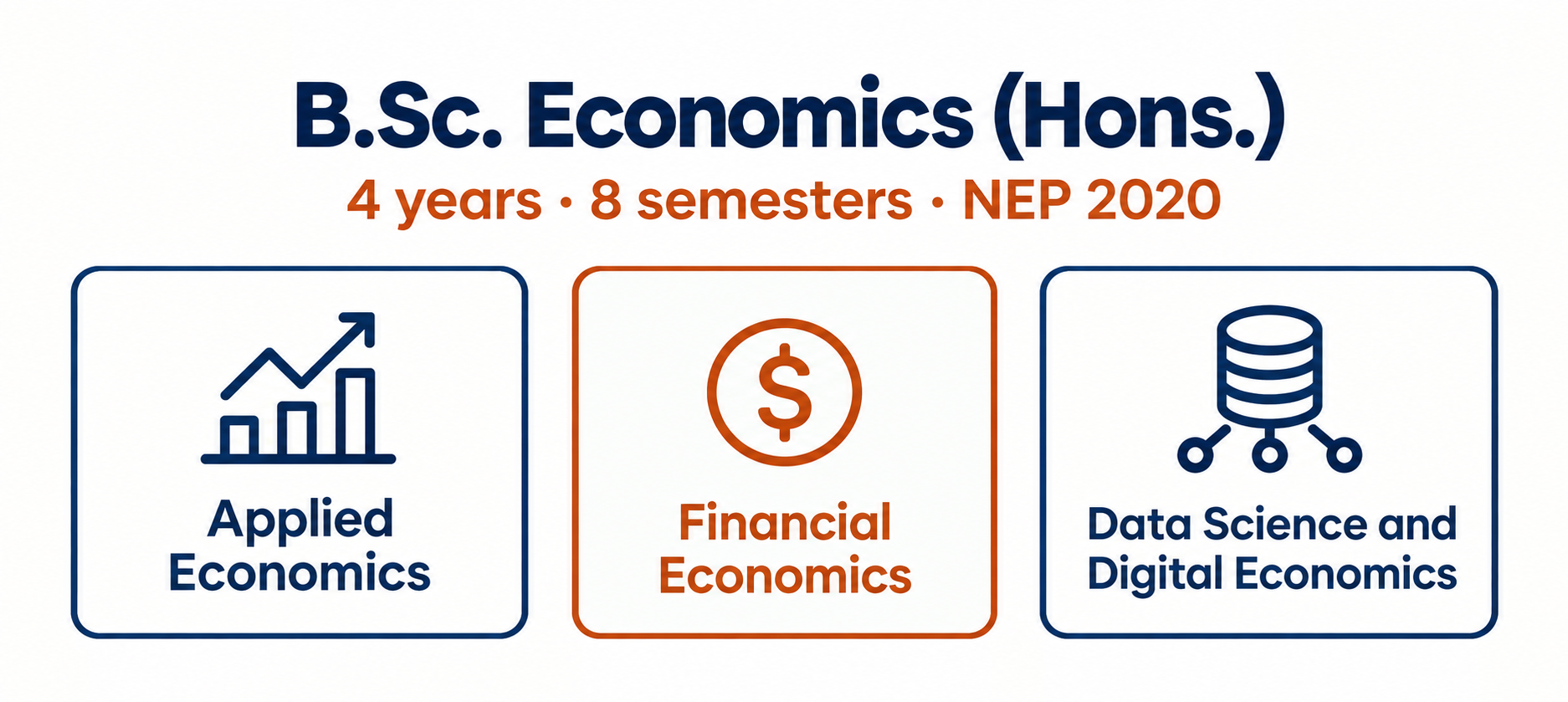
The B.Sc. (Hons.) Economics is a four-year, interdisciplinary programme aligned with NEP 2020, offering a strong foundation in economic theory, quantitative methods, data analytics, finance, public policy, and contemporary economic issues. The programme develops analytical reasoning, statistical skills, research abilities, and evidence-based decision-making through coursework, internships, projects, and practical applications.
Students can specialise in Applied Economics, Financial Economics, or Data Science and Digital Economics. The Applied Economics track focuses on development, public finance, sustainability, and policy; Financial Economics covers financial markets, banking, investment, and risk management; while Data Science and Digital Economics integrates economics with data science, technology, digital platforms, and data-driven markets. Graduates are prepared for careers in banking, finance, analytics, consulting, research, public policy, development, and corporate strategy, as well as higher studies.
The Applied Economics track enables students to examine real-world economic challenges by applying theoretical frameworks, quantitative tools, and empirical analysis. The track focuses on the practical application of economic concepts to areas such as public policy, development economics, environmental sustainability, labour markets, and economic planning.
Students engage with advanced courses that explore the functioning of economic institutions, government policies, and development processes in both national and global contexts. Through analytical study of issues such as economic growth, inequality, poverty, public finance, and sustainable development, students develop the ability to interpret economic trends and evaluate policy interventions.
The track is supported by training in econometrics, statistical analysis, and research methodology, enabling students to analyse economic data, evaluate development programmes, and conduct evidence-based policy research. Students also gain experience in policy analysis, economic modelling, and applied research projects, which strengthen their ability to translate economic theory into practical policy insights.
Experiential learning plays an important role in this track. Internships, case studies, and field-based research projects allow students to observe economic policy implementation and development initiatives in real-world contexts such as government departments, policy think tanks, development organisations, and research institutions.
Graduates of the Applied Economics track are well prepared for careers in economic policy analysis, development organisations, government agencies, consulting firms, and research institutions, as well as for postgraduate studies in economics, public policy, development studies, and related interdisciplinary fields.
The Financial Economics track focuses on the study of financial markets, banking systems, investment strategies, and risk management from an economic perspective. The track equips students with analytical and quantitative skills required to understand the functioning of modern financial systems and the interaction between financial markets and the broader economy.
Students explore key areas such as financial markets and institutions, investment analysis, behavioural finance, banking systems, financial regulation, and risk management. These courses provide insights into the dynamics of capital markets, asset pricing, financial instruments, and the role of financial institutions in economic development.
The track integrates quantitative analysis, econometrics, and financial modelling, enabling students to evaluate financial data, interpret market trends, and assess investment opportunities. Students also develop competencies in financial data analysis, portfolio evaluation, and economic forecasting, supported by analytical tools and digital platforms used in financial analysis.
Practical exposure through internships, financial simulations, case studies, and project-based assignments allows students to engage with real-world financial environments, including banks, financial services firms, investment companies, consulting organisations, and fintech enterprises.
Graduates of the Financial Economics track are well prepared for careers in banking, financial analysis, investment research, risk management, financial consulting, and corporate finance, and are also well positioned to pursue advanced studies in financial economics, finance, business administration, and related professional fields.
The Data Science and Digital Economics track explores the intersection of economics, data science, and digital technologies. The track equips students with the analytical and computational skills required to understand data-driven economies and the rapid transformation of markets through digital platforms and technological innovation.
Students learn to analyse economic phenomena using data analytics, statistical modelling, and computational techniques, supported by training in tools such as Python, Excel, and data visualisation software. These courses enable students to manage large datasets, perform predictive analysis, and interpret economic patterns using modern data science methods.
The track also explores the economics of digital platforms, e-commerce, fintech, artificial intelligence, and the platform economy, examining how technological innovations are reshaping markets, business models, labour systems, and global economic structures.
Students develop competencies in data analysis, economic modelling, algorithmic thinking, and digital market analysis, while gaining experience through data-driven research projects, applied analytics assignments, and internships with analytics firms, technology companies, and research organisations.
Graduates of the Data Science and Digital Economics track are well prepared for careers in data analytics, economic research, business intelligence, digital consulting, fintech, and technology-driven industries, as well as for advanced study in data science, economics, analytics, and digital policy.
English
Semester
*Semester fee is subject to change as per the approval of the Fee Fixation Committee.
The B.Sc. (Hons.) Economics programme at the School of Humanities and Social Sciences, DYPIU prepares students for diverse and dynamic career opportunities across industry, government, research, and academia. The specialised tracks enable students to pursue targeted career pathways aligned with their interests and skill sets.
Graduates of the Applied Economics track are equipped to engage with real-world economic challenges through policy analysis, development planning, and research.
Career Opportunities:
Employment Sectors:
Graduates may pursue postgraduate studies in Economics, Public Policy, Development Studies, Environmental Economics, or Governance and Policy Studies, both in India and abroad.
Graduates of the Financial Economics track develop expertise in financial systems, markets, and investment analysis, preparing them for careers in the financial services sector.
Career Opportunities
Employment Sectors
Graduates may pursue advanced studies in Finance, Financial Economics, MBA (Finance), Banking and Financial Services, or Professional Certifications such as CFA, FRM, or related qualifications.
Graduates of the Data Science and Digital Economics track are prepared for data-driven roles in modern digital and technology-enabled economic environments.
Career Opportunities:
Employment Sectors:
Graduates may pursue postgraduate studies in Data Science, Economics, Business Analytics, Digital Economics, Artificial Intelligence, or Computational Social Sciences.
Irrespective of specialisation, graduates of the programme are well prepared for roles in:
The programme also provides a strong foundation for preparing for competitive examinations, higher education, and professional certifications.
The B.Sc. (Hons.) Economics programme at the School of Humanities and Social Sciences, D Y Patil International University (DYPIU), Akurdi, Pune offers a rigorous and forward-looking undergraduate education that combines strong theoretical foundations with advanced analytical and practical skills. Designed in alignment with the National Education Policy (NEP) 2020, the programme prepares students to understand complex economic systems, analyse public policy, and interpret data-driven insights in an increasingly interconnected global economy.