header bg

B.Tech. - Mechanical Engineering with Artificial Intelligence and Machine Learning at DYPIU

B.Tech. - Mechanical Engineering (AI & ML)

B.Tech. Mechanical Engineering (Artificial Intelligence & Machine Learning) Program Overview

Welcome to the Bachelor of Technology in Mechanical Engineering (Artificial Intelligence & Machine Learning) program at D Y Patil International University, where mechanical engineering meets intelligent technologies to shape the future of manufacturing and industrial innovation.
engineering

DYPIU offers a full-time, four-year B.Tech. program in Mechanical Engineering with a specialized focus on Artificial Intelligence and Machine Learning. The curriculum has been carefully designed through collaboration with academic experts, industry leaders, AI professionals, and manufacturing organizations to prepare graduates for the rapidly evolving world of smart engineering. The program integrates strong mechanical engineering fundamentals with advanced computational intelligence, enabling students to develop innovative, intelligent, and sustainable engineering solutions for Industry 4.0 and Industry 5.0. The rapid advancement of Artificial Intelligence, Machine Learning, Industrial Internet of Things (IIoT), Robotics, and Digital Technologies is transforming the global manufacturing sector. Modern mechanical engineers are expected not only to design and manufacture products but also to develop intelligent systems capable of autonomous decision-making, predictive analysis, process optimization, and real-time monitoring. This interdisciplinary program equips students with the knowledge and practical skills required to become next-generation engineers capable of leading digital transformation across manufacturing, automotive, aerospace, robotics, energy, and industrial automation sectors.

  • Artificial Intelligence and Machine Learning : Artificial Intelligence and Machine Learning enable engineers to develop intelligent systems capable of learning from industrial data, predicting equipment behaviour, optimizing manufacturing processes, improving product quality, and supporting autonomous engineering decisions.
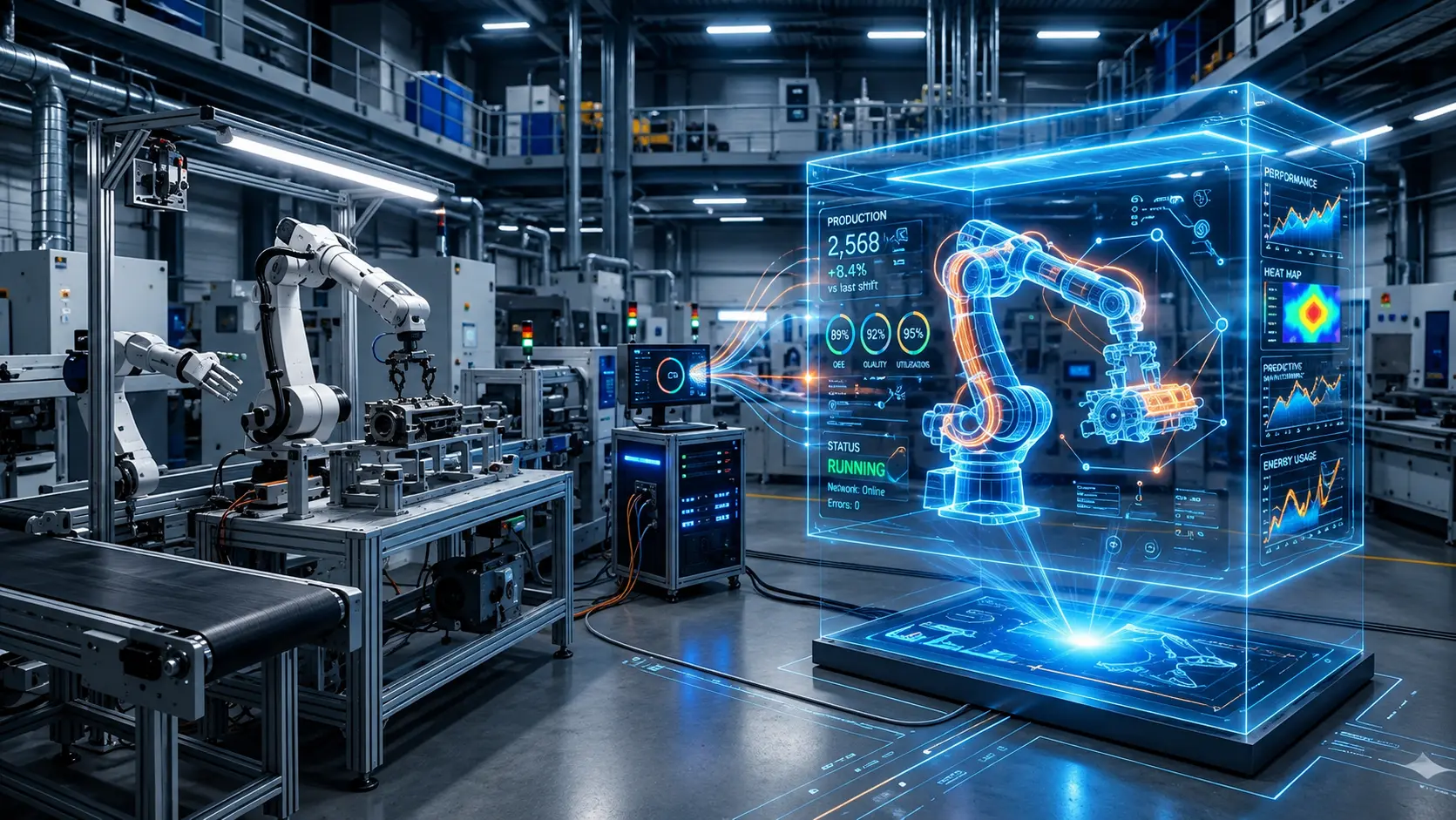
  • Intelligent Manufacturing : Intelligent Manufacturing integrates AI, data analytics, robotics, and cyber-physical systems to create adaptive production environments capable of real-time monitoring, self-optimization, and zero-defect manufacturing while improving productivity, quality, and operational efficiency.
  • Digital Twin Technology : Digital Twin technology creates virtual replicas of machines, manufacturing systems, and industrial processes, enabling engineers to perform simulation, virtual commissioning, predictive maintenance, and lifecycle optimization without interrupting actual production.
  • Predictive Maintenance Analytics : Predictive Maintenance combines industrial sensor data with Machine Learning algorithms to predict equipment failures before they occur. This approach minimizes unexpected downtime, reduces maintenance costs, improves equipment reliability, and maximizes operational efficiency.
  • Robotics and Intelligent Automation : Modern manufacturing increasingly relies on collaborative robots (Cobots), industrial robotics, autonomous guided vehicles (AGVs), and AI-based automation systems. Students gain practical exposure to robot programming, motion planning, computer vision, and intelligent industrial automation.
  • Industrial Internet of Things (IIoT) : IIoT enables seamless connectivity between machines, sensors, controllers, and cloud platforms. Students learn how industrial data is collected, transmitted, analyzed, and utilized to improve productivity, asset utilization, and decision-making in smart factories.
  • Computer Vision and Quality Inspection : Computer Vision enables automated inspection and quality control using cameras, deep learning, and image processing techniques. AI-powered vision systems improve defect detection, dimensional inspection, and manufacturing accuracy while reducing human intervention.
  • Data Analytics for Engineering Systems : Engineering Data Analytics applies statistical methods, Machine Learning, and visualization tools to transform large-scale industrial data into meaningful insights for process optimization, energy management, supply chain improvement, and engineering decision support.
  • Smart Factory and Industry 5.0 : Industry 5.0 emphasizes collaboration between humans and intelligent machines to create sustainable, resilient, and human-centric manufacturing systems. Students develop expertise in smart factories integrating AI, robotics, digital twins, cloud computing, and cyber-physical systems for the next generation of industrial innovation.

Course Structure of B.Tech. - Mechanical Engineering (AI & ML)

The first four semesters of the B.Tech. Mechanical Engineering (Artificial Intelligence & Machine Learning) program follow the common curriculum of Mechanical Engineering, providing students with a strong foundation in engineering sciences, mathematics, manufacturing, mechanics, design, and computational thinking. From Semester V onwards, students pursue the Artificial Intelligence & Machine Learning Specialization, where core mechanical engineering concepts are integrated with Artificial Intelligence, Machine Learning, Data Science, Robotics, Computer Vision, Industrial Internet of Things (IIoT), Digital Twin Technology, and Intelligent Manufacturing. This interdisciplinary curriculum prepares graduates for Industry 4.0 and Industry 5.0 applications.

Semester 1
Elements of Mechanical Engineering (Theory)
Engineering Graphics (Theory)
Engineering Graphics (Lab)
Design Thinking Laboratory (Fabrication Lab) (Theory)
Design Thinking Laboratory (Fabrication Lab)
Engineering Physics (Theory)
Engineering Physics (Lab)
Computational Thinking with Python (Theory)
Computational Thinking with Python (Lab)
Engineering Mathematics
Indian Knowledge System
Semester II
Manufacturing Process and Shop Floor Operation (Theory)
Manufacturing Process and Shop Floor Operation (Lab)
Applied Mathematics
Engineering Chemistry (Theory)
Engineering Chemistry (Lab)
Engineering Mechanics (Theory)
Engineering Mechanics (Lab)
Basics of Electrical and Electronics Engineering (Theory)
Basics of Electrical and Electronics Engineering (Lab)
Biology for Engineers
Soft Skills (Audit Course)
Semester III
Thermodynamics
Computer Aided Design and Drawing
Metrology and Quality Systems
Solid Mechanics
Technology Management & Commercialization
Professional Skill – I
Advanced Machine Shop
Environmental Science & Sustainable Development
Rural Development Internship – I
Semester IV
Engineering Materials and Metallurgy
Energy Conversion
Fluid Machinery
Data Science and Machine Learning
Kinematics of Mechanisms and Machine Elements
Skill Development
Professional Skill – II
Semester V
Computational Techniques
Heat Transfer
Robotics and Automation
Mechanical System Component Design
Elective – I
Internship – II
Professional Skill – III
Semester VI
Hydraulics and Pneumatics Systems
Control Engineering
Artificial Intelligence in Autonomous Vehicles & Aerospace
Sensors and Industrial Internet of Things (IIoT)
Industrial Automation and Digital Twin Technologies
Research Methodology (Audit)
Internet of Things Laboratory
Open Elective
Professional Skill – IV
Semester VII
Machine Diagnostics and Condition Monitoring
Generative AI for Engineering Design
Engineering Estimation & Costing
Automobile Engineering
Finite Element Analysis
Elective – II
Internship – III
Semester VIII
Capstone Project (Industry Sponsored)
Program Electives / Honors Courses
Elective Courses
Elective – I
  • Big Data Analytics in Mechanical Systems
  • Digital Signal Processing Techniques
  • Reinforcement Learning for Autonomous Systems
Elective – II
  • Soft Computing
  • Advanced Control Systems
  • Deep Learning for Mechanical Engineering
Sr No Courses
1 Electrical Vehicles
  • Electric Vehicle Technology
  • EV Powertrain Design
  • Battery Systems and Management
  • Electric Vehicle Dynamics
2 Systems Applications and Products in Data Processing (SAP)
  • Introduction to SAP
  • SAP Implementation Methodology
  • SAP – Materials Management (Procurement)
  • SAP – SCM Planning and Manufacturing
Rules and Regulations for Honours/Minors Programs (Applicable to Artificial Intelligence & Machine Learning Specialization)
  • R1.1: It is not mandatory for students enrolled in the Artificial Intelligence & Machine Learning (AI & ML) specialization to opt for the Honors or Minors program. Students may voluntarily register for Honors/Minors subjects from Semester V to Semester VIII based on their interests. Once a student selects an Honors/Minors program related to Artificial Intelligence, Machine Learning, Data Science, Robotics, Intelligent Automation, or allied emerging technologies, the selected program cannot be changed in subsequent semesters.
  • R1.2: Registration in the Honors/Minors program enables students to earn additional academic credits beyond the requirements of the AI & ML specialization curriculum. These credits shall be recorded separately in the University records. Upon successful completion of the Honors/Minors program, the earned credits will be reflected in the Semester VIII-mark sheet. Students who fail to complete the prescribed Honors/Minors credits shall not receive recognition of these additional credits in the final mark sheet.
  • R1.3: Credits earned through the Honors/Minors program in Artificial Intelligence & Machine Learning or related disciplines shall not be considered in the calculation of SGPA or CGPA. The SGPA and CGPA will be computed only on the basis of the mandatory subjects prescribed under the approved B.Tech. Mechanical Engineering (Artificial Intelligence & Machine Learning) curriculum.
  • R1.4: Students enrolled in the Honors/Minors program must complete all prescribed credits within four academic years beginning from Semester V. Honors/Minors certification will be awarded only after successful completion of both the B.Tech. Mechanical Engineering (Artificial Intelligence & Machine Learning) program and the respective Honors/Minors requirements. Students may voluntarily withdraw from the Honors/Minors program during this period. Upon successful completion of the mandatory graduation requirements, the regular B.Tech. Mechanical Engineering (Artificial Intelligence & Machine Learning) degree shall be awarded.
  • R1.5: Backlog subjects arising from the Honors/Minors program shall not be considered while determining the ATKT (Allowed to Keep Terms) status for progression in the B.Tech. Mechanical Engineering (Artificial Intelligence & Machine Learning) program.
Examination Scheme (Applicable to AI & ML Honors/Minors)
  • R2.1: Examinations for Honors/Minors subjects related to Artificial Intelligence & Machine Learning, such as Data Science, Deep Learning, Robotics, Computer Vision, Industrial AI, Digital Twin Technology, Intelligent Manufacturing, Internet of Things (IoT), and related emerging technologies shall be conducted at the University level. The question paper shall be common for all students registered under the respective Honors/Minors program.
  • R2.2: Students registered for the Honors/Minors program shall be required to pay additional examination fees as prescribed by the University. These fees shall cover expenses related to question paper setting, examination conduct, evaluation, answer-book assessment, and certification.

Eligibility Criteria & Fees Structure for B.Tech. - Mechanical Engineering (AI & ML) Admission at DYPIU

Duration – 4 years

Qualifying Examination:

Candidates must have passed the 10+2 examination with Physics, Mathematics, Chemistry, Computer Science, Electronics, Information Technology, Biology, Informatics Practices, Biotechnology, Technical Vocational Subject, Agriculture, Engineering Graphics, Business Studies, or Entrepreneurship, and obtained at least 45% aggregate marks (40% marks for candidates belonging to reserved categories) in the above subjects taken together.

OR

Passed D.Voc. Stream in the same or allied sector.

Mandatory Subjects: Physics, Chemistry and Mathematics

Bridge Courses: DY Patil International University will offer suitable bridge courses in Mathematics, Physics, Programming Fundamentals, and Computational Thinking for students coming from diverse educational backgrounds to ensure a common foundation and achieve the desired learning outcomes of the program.

Selection Criteria: Students with good scores in MH-CET, PERA CET, CUET, or any other equivalent competitive exams, DYPIU Entrance Test and/or Personal Interaction.

Lateral Entry to Direct Second Year

Duration – 3 Years

The candidate should satisfy the following eligibility criteria:

(i) The candidate should be an Indian National.

(ii) Passed a minimum Three-Year Diploma or Two-Year (Lateral Entry) Diploma in Engineering and Technology with at least 45% marks (40% marks for candidates belonging to Backward Class Categories, Economically Weaker Section (EWS), and Persons with Disabilities (PwD) belonging to Maharashtra State) from an AICTE-approved or Central/State Government-recognized institution or its equivalent.

OR

Passed a B.Sc. Degree from a UGC/AIU-recognized University with at least 45% marks (40% for reserved category candidates) and passed the Higher Secondary Examination (HSC) or its equivalent with Mathematics as one of the subjects.

OR

Passed a Three-Year D.Voc. Stream in the same or allied sector.

B.Tech. Mechanical Engineering (Artificial Intelligence & Machine Learning) Fees Structure

  • Tuition Fee: ₹1,05,000/- per semester
  • Registration Fee: ₹2,500/- per semester
  • Caution Deposit: ₹10,000/- (One-time refundable at the completion of the program)

Note: Semester fees are subject to revision as per the approval of the University Fee Fixation Committee.

FAQ's- B.Tech. - Mechanical Engineering (AI & ML)

B.Tech. in Mechanical Engineering (Artificial Intelligence & Machine Learning) is a four-year undergraduate engineering program that combines the strong fundamentals of Mechanical Engineering with emerging technologies such as Artificial Intelligence (AI), Machine Learning (ML), Data Science, Robotics, Digital Twin, Industrial Internet of Things (IIoT), and Intelligent Manufacturing. The program prepares students to design, develop, optimize, and automate modern engineering systems for Industry 4.0 and Industry 5.0.

Both programs share the same core mechanical engineering fundamentals, including thermodynamics, fluid mechanics, machine design, manufacturing, materials science, and engineering mechanics.

However, the AI & ML specialization integrates advanced subjects such as:

  • Artificial Intelligence
  • Machine Learning
  • Deep Learning
  • Data Science
  • Computer Vision
  • Industrial AI
  • Robotics and Automation
  • Digital Twin Technology
  • Predictive Maintenance
  • Smart Manufacturing
  • Industrial IoT

The program emphasizes practical implementation of intelligent technologies for modern manufacturing industries.

The curriculum includes multiple internship opportunities throughout the program.

  • Community and rural engineering projects
  • Industrial training in manufacturing and automation industries
  • AI and Machine Learning-based engineering projects
  • Research and innovation projects
  • Start-up and entrepreneurship projects

Students may undertake internships both within and outside the University during semester breaks. During academic semesters, University-based internships are recommended for better academic coordination.

Students should develop both engineering and computational skills, including:

  • Mechanical Engineering Fundamentals
  • Artificial Intelligence and Machine Learning
  • Programming (Python, MATLAB)
  • Data Analytics
  • Problem Solving
  • Robotics and Automation
  • Computer Vision
  • Digital Twin Development
  • Critical Thinking
  • Innovation and Creativity
  • Communication Skills
  • Teamwork and Leadership
  • Project Management
  • Entrepreneurship

DY Patil International University follows a student-centric specialization model where students receive focused education in emerging technologies.

The B.Tech. Mechanical Engineering (Artificial Intelligence & Machine Learning) program itself is a specialized undergraduate degree integrating mechanical engineering with AI and intelligent manufacturing technologies. Students receive extensive exposure to AI-based engineering applications through advanced laboratories, industry projects, internships, and capstone projects.

Yes.
Unlike conventional elective-based programs, the Artificial Intelligence & Machine Learning specialization provides a structured curriculum where AI, Machine Learning, Robotics, Digital Twin, Computer Vision, and Industrial AI are integrated throughout the later semesters. This enables students to graduate with strong interdisciplinary expertise rather than isolated elective knowledge.

Students who successfully complete all academic requirements will be awarded the degree: Bachelor of Technology (B.Tech.) in Mechanical Engineering (Artificial Intelligence & Machine Learning).

The specialization title will appear on the degree certificate and academic transcript.

The proposed intake for the B.Tech. Mechanical Engineering (Artificial Intelligence & Machine Learning) program is 30 students per academic year, ensuring personalized learning, advanced laboratory access, and effective industry mentoring.

Students are encouraged to participate in:

  • SAE, ASME, IEEE and ISTE Student Chapters
  • AI & Robotics Club
  • Coding Club
  • Innovation and Entrepreneurship Cell
  • Smart India Hackathon
  • SIH Hardware Edition
  • Robocon
  • Baja SAE
  • Go-Kart Competitions
  • National and International Technical Competitions
  • Research Conferences
  • Industrial Visits
  • Start-up Incubation Programs

Yes. Students are encouraged to participate in:

  • Faculty-guided research projects
  • AI-based manufacturing research
  • Robotics and automation research
  • Digital Twin development
  • Product innovation
  • Patent filing
  • Start-up incubation
  • Funded research projects
  • International conferences and journal publications

Yes. The University provides placement assistance through the Corporate Relations and Placement Cell.

Graduates are eligible for placements in:

  • Manufacturing Industries
  • Automotive Companies
  • Electric Vehicle Industries
  • Aerospace Industries
  • Robotics Companies
  • AI & Software Companies
  • Automation Industries
  • Industrial IoT Companies
  • Consulting Organizations
  • Research & Development Centres
  • Government Organizations
  • Technology Start-ups

Students are also eligible for cross-disciplinary placements in AI, Data Science, Automation, Software Development, and Digital Manufacturing domains.

Graduates can explore opportunities with organizations such as:

  • Tata Motors
  • Mahindra & Mahindra
  • Bosch
  • Siemens
  • ABB
  • Fanuc
  • KUKA Robotics
  • Bharat Forge
  • Cummins India
  • Atlas Copco
  • SKF
  • General Electric
  • Honeywell
  • Rockwell Automation
  • Schneider Electric
  • Accenture
  • TCS
  • Infosys
  • Wipro
  • Cap Gemini
  • Cognizant
  • KPIT Technologies
  • NVIDIA
  • Microsoft
  • Google
  • Amazon Web Services (AWS)

Yes. Graduates can pursue:

  • M.Tech.
  • MS (India/Abroad)
  • MBA
  • Ph.D.
  • Specialized certifications in AI, Robotics, Data Science, Cloud Computing, and Industrial Automation.

The program combines classical Mechanical Engineering with Artificial Intelligence to prepare future-ready engineers through:

  • Industry-aligned curriculum
  • AI-enabled Mechanical Engineering
  • Digital Twin Technology
  • Intelligent Manufacturing
  • Robotics & Automation
  • Computer Vision
  • Predictive Maintenance
  • Industrial IoT
  • AI laboratories
  • Industry internships
  • Live industrial projects
  • Research opportunities
  • Start-up incubation support
  • Outcome-Based Education aligned with Industry 4.0 and Industry 5.0
Apply Now
Prospectus